
Reusing Greywater in the Garden Depends on Which Water You Collect
You already have the water. The shower runs for a minute before it warms up. The washing machine empties its rinse twice a week. And spring is drying the garden out.
That used water is greywater, and some of it can go on the garden. Not all of it, and not on every plant. This post sorts out which is which.
Here’s the short version. In Victoria, laundry rinse and shower water can go on ornamental garden beds without council approval. Use it within 24 hours. Let it soak in below the surface. Keep it off anything you eat. Kitchen water stays out, any change to the plumbing needs a licensed plumber, and a treatment system needs a certificate of approval.
This post covers Victoria and the Northern Territory. It’s general guidance, not a ruling on your street. Your council or water corporation can confirm the local rules.
Which water counts as greywater
EPA Victoria describes greywater as household wastewater from baths, showers, bathroom sinks, laundries and kitchens. It doesn’t include toilets. But for untreated reuse, the EPA leaves out kitchen wastewater.
The Better Health Channel agrees. It says not to use water from the kitchen sink or the dishwasher, because of the grease, bacteria and chemicals in it. The Northern Territory Government says the same thing a different way. Kitchen wastewater has fats, oils and grease in it, and it needs to go to the sewer or a septic tank.
Water from washing soiled nappies is a different case again. Better Health treats it as blackwater, not greywater.
One more point before the list. EPA Victoria is clear that greywater isn’t drinking water. Kitchen water doesn’t get a new job either. It carries on down the drain to the sewer or septic tank, the way it always has.
Here’s the quick sort.
- Shower: yes
- Bath: yes
- Bathroom basin: yes
- Laundry rinse: yes
- Kitchen sink: no
- Dishwasher: no
- Nappy wash: no
Start with the shower bucket and the laundry. They’re the easy ones.
Low risk and high risk, side by side
Better Health sets out the risks in three pairs. It’s a handy way to see where to begin, so here they are in one table.
Greywater risk, from the Better Health Channel
| Lower risk | Higher risk | Source |
|---|---|---|
| Laundry rinse water | Kitchen water | Better Health Channel |
| Sub-surface irrigation pipes | Hosing the garden with untreated greywater | Better Health Channel |
| Ornamental plants | Vegetable gardens | Better Health Channel |
Most of the higher-risk column is about extra care, but three entries are ruled out. Kitchen water is out for untreated reuse, according to the EPA. Better Health says plainly not to hose, spray or mist untreated greywater. And it says not to use greywater on vegetables, fruit, herbs or anything you plan to eat.
So why does it matter? Better Health says microbes can survive longer on topsoil. And plants you eat go straight from the garden to the kitchen. Put those two facts together and the table makes sense. Keep the water low and underground, and keep it away from the food.
Take the three pairs one at a time. Laundry rinse water sits on the lower side and kitchen water on the higher, because of what the kitchen adds: the grease, bacteria and chemicals Better Health mentions. Pipes below the surface sit lower than a hose, because Better Health says all irrigation should be located sub-soil. And ornamental plants sit lower than a vegetable garden, because nothing in an ornamental bed ends up on a plate.
The bucket and the temporary hose
Better Health says untreated greywater can be used in dry periods, by hose or diversion device, or by carrying it in a bucket. In Victoria, council approval isn’t needed for this. A bucket under the shower and a walk to the garden bed is the simplest version of it. Better Health frames this as something for dry periods, which is also when the garden is thirstiest.
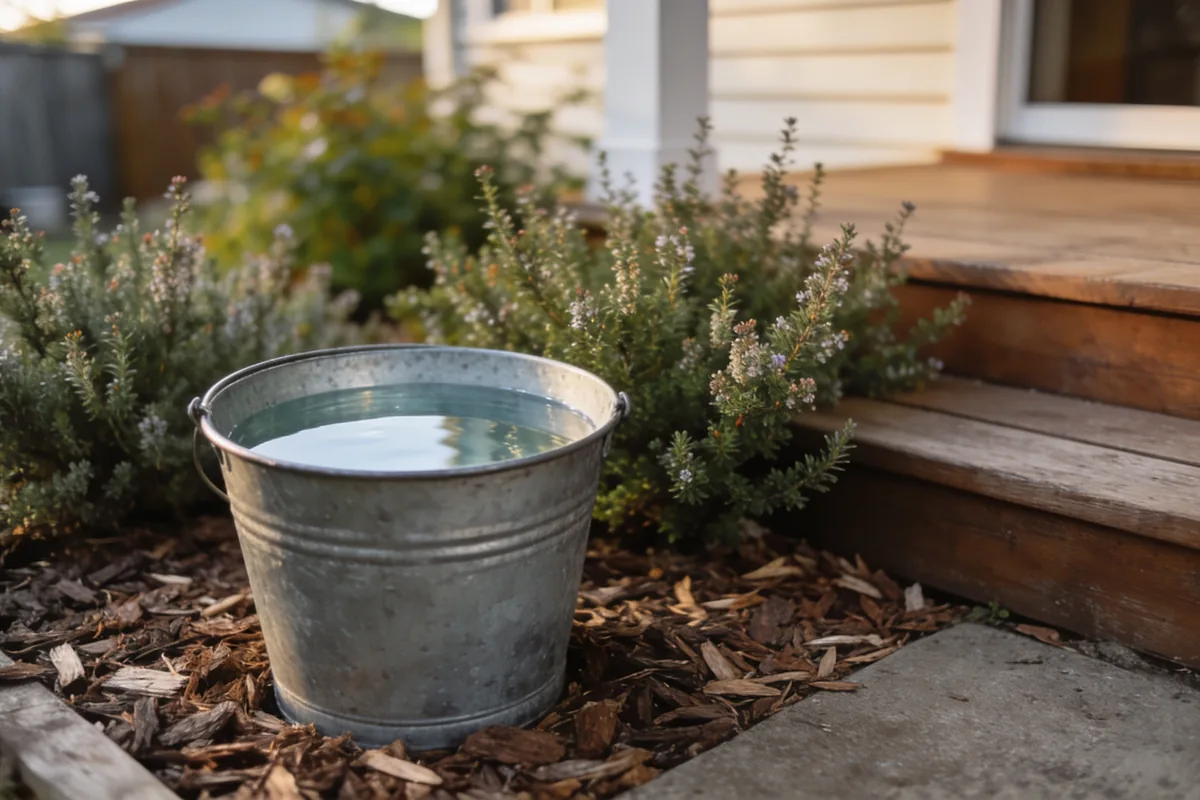
Use it fast. EPA Victoria says untreated greywater “begins to turn septic and smell if it’s stored for longer than 24 hours”. Better Health says not to store it longer than that. The NT says not more than a day. So the rule is the same in both places. Say you fill a bucket from the shower on Saturday morning. It needs to be on the garden before Sunday morning. Say the washing machine empties on Tuesday afternoon. The same clock applies. The easiest habit is to carry it out the day you collect it.
Now the hose. Better Health lets you use one. On the same page it also says “Never hose, spray or mist untreated greywater” and that all irrigation should be sub-soil. Those two lines look like they clash.
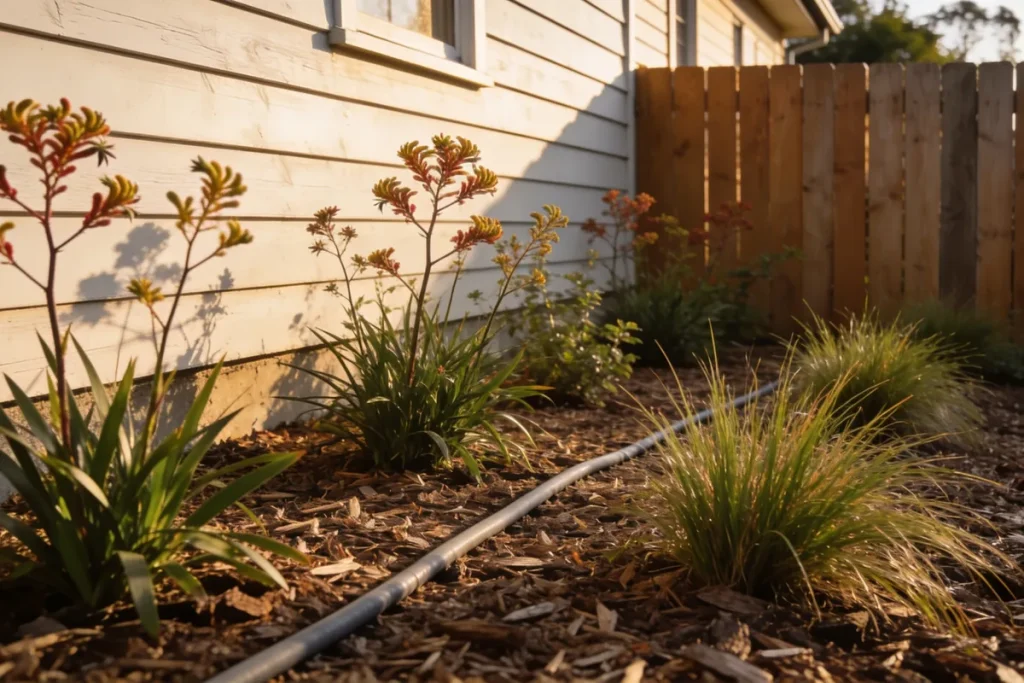
The kit is short. A bucket. A length of hose. A garden bed with mulch on top. If you’ve got those three, you’re set.
Here’s one way to read the two lines. A temporary hose laid so the water runs out at soil level, under the mulch, is the bucket’s equivalent. The water goes into the ground and not into the air. What the page rules out is spraying or hosing over plants. So lay the hose under the mulch. Let it run out at soil level. Move it around the bed. Never point it up.
A few more habits help.
- Skip it in wet weather and when the soil is already sodden. Better Health says so, and so does the NT.
- Don’t let it pond. The NT adds that greywater must not run onto a neighbour’s property.
- Don’t keep watering one spot. The NT suggests rotating with mains or rainwater to flush out salts.
A common view among gardeners is that the washing machine hose has worked fine for years. That view isn’t far from the official advice. The advice doesn’t ban the habit. It adds a few rules around it: the 24 hours, the no-spray rule and the vegetable rule.
What not to water, and who to keep away
Better Health is clear on this one. Never use untreated greywater on vegetables, fruit, herbs or anything you plan to eat. Keep the vegie patch on tap water or rainwater.
There’s one gentle wrinkle. The NT page says greywater can be reused on lawns and gardens, and it doesn’t mention vegetables at all. That silence doesn’t make vegetables fine. For anything you eat, follow the stricter health advice from Better Health.
A few people-and-pet points sit alongside that.
- Keep children away from the irrigated area. The NT says to keep them away until the water has soaked in.
- Don’t let pets drink it.
- Don’t use greywater at all if someone in the house is sick. That’s the NT’s advice.
- Wash your hands before you eat. Both Better Health and the NT say this, and the NT adds before drinking or smoking.
If you’re thinking of replanting around the greywater area, a local gardener can help you plan which beds get the water and which stay on tap. That’s a good job for a weekend. Ornamental beds on one side and the edible patch on the other is a simple layout. It also makes the rule easy to remember, because the water only ever goes to one side of the yard.
None of these points are hard on their own. Together they’re the reason the official advice sounds cautious. A child playing near a damp bed, a dog at a puddle and a tomato plant in the wrong spot are all small things that the advice is trying to head off.
Your detergent matters more than you think
The water isn’t just water. It carries whatever went into the wash. Better Health lists ingredients that can harm or kill plants: total salts, sodium, chloride and boron.
So read the label. If it names any of those, you’ve found something worth a second look. Better Health suggests choosing phosphate-free or low-phosphate cleaners and detergents. That’s all it takes to start.
Watch the plants, too. If they look damaged, the NT says to use less water or spread it over a wider area. Rotating with fresh water now and then helps as well. A bed that gets greywater week after week is the one most likely to show it.
You don’t need a special product. You don’t need to name a brand. Just check the label, and pick the gentler option when you next buy.
When it becomes a plumbing job
A bucket and a temporary hose are one thing. A treatment system is another. That’s where the paperwork starts.
In Victoria, Better Health says greywater treatment systems must have a certificate of approval. It says to consult a licensed plumber before tapping into the plumbing. And it says all household plumbing work must be done by a licensed plumber and comply with AS 3500. EPA Victoria adds that you need a permit to construct, install or alter an onsite wastewater management system. Check with your council, your water authority or the Department of Health.
So if you’re thinking beyond the bucket, ring a licensed plumber first.
The Northern Territory does it a little differently. There, you don’t need approval for a greywater diversion device if three things are true.
- It serves a single house.
- It’s installed by a licensed plumber and drainer.
- It’s connected to the sewer or a septic tank.
The device must also release the water below the ground surface. It must not store it for long periods. And it must not be used with kitchen water or to spray. Treated greywater indoors, for toilets or the washing machine, is allowed only in a single house, again plumbed by a licensed plumber and drainer.
Here’s how the two places sit side by side. In Victoria, Better Health says diverting untreated greywater needs no council approval, but the plumbing work must be done by a licensed plumber to AS 3500, a treatment system needs a certificate of approval, and EPA Victoria requires a permit for an onsite wastewater management system. The NT lets a diversion device go ahead without approval, if those three conditions are met. Either way, a licensed plumber is part of the picture.
One last note on septic. The NT connection condition is just that, a condition of the diversion device. It’s not a guide to septic systems, which this post doesn’t cover.
Start With the Laundry Rinse
Here’s the whole job on one list.
- Pick one bed of ornamentals.
- Use the rinse water the same day, within 24 hours.
- Carry it in a bucket, or lay a hose under the mulch.
- Skip it when it rains or the soil is sodden.
- Swap to a low-phosphate detergent when you next buy one.
- Keep the vegie patch on tap or rainwater.
Start with the first line. Pick the bed. The rest will follow from there.
Sources: Better Health Channel (Victorian Department of Health), Greywater: recycling water at home, reviewed 31 July 2013 (https://www.betterhealth.vic.gov.au/health/healthyliving/greywater-recycling-water-at-home); EPA Victoria, Reuse greywater safely, updated 18 May 2025 (https://www.epa.vic.gov.au/reuse-greywater-safely); Northern Territory Government, Reuse greywater at home (https://nt.gov.au/property/building-and-development/wastewater-management/greywater-reuse)