
Plan a Phillip Island Day Trip Backwards From the Penguin Parade
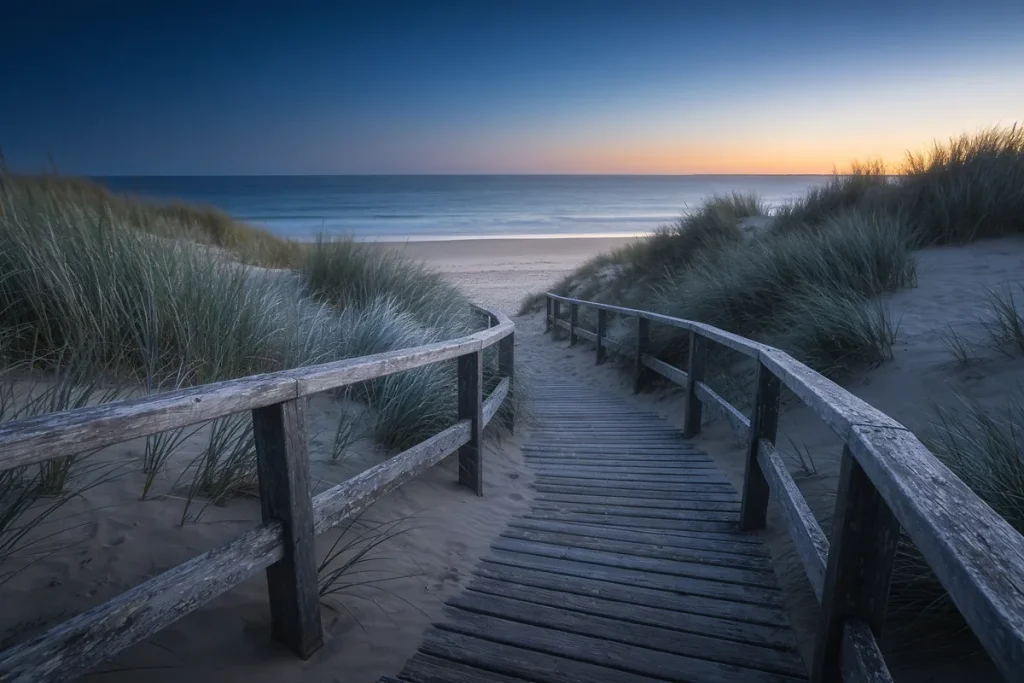
The wind comes straight off Bass Strait at Summerland Beach, carrying salt and the smell of cold sand. A timber boardwalk winds out through the tussock grass in the last of the light. Behind it a grandstand is filling, row by row, with people in jackets and beanies, rugs over their knees and children wedged in between. Nobody is looking at anything in particular. Everyone is watching the waterline.
It is an odd sort of quiet for a crowd. Voices drop. A child asks a question in a whisper and is shushed, gently. The sky shifts from orange to a deeper, cooler blue, and the sea keeps arriving at the sand.
This is the Phillip Island Penguin Parade, and the whole day on the island turns on it. The early start, the lunch, the stop at the headland, the drive home: every one of those choices was made around this half hour. The day does not really begin in the morning. It begins at the beach at dusk, and a sensible visitor works that out first and builds everything else backwards from it.
Why the Phillip Island Penguin Parade sets the day
The penguins keep their own hours. According to Phillip Island Nature Parks, which looks after the site, little penguins come ashore at sunset every evening of the year, and the colony is described as the largest little penguin colony in the world. Viewing runs every night. That makes the parade the one fixed point on an island, which the Nature Parks’ page also names Milawul, that is otherwise full of choices. Lunch can move. A stop can be skipped. Sunset cannot be moved at all.
Two practical facts follow from that. The first is that bookings are essential, so the ticket comes before the rest of the plan, not after it. The second is that the time shifts through the year. Sunset in January is not sunset in June, so the Nature Parks publish a penguin arrival calendar, and the number that matters is the one listed against the date of the visit.
There is a complication in the middle of summer. From mid-December to late January, and again across long weekends and school holidays, the Nature Parks say the traffic can get busy and ask visitors to allow extra travel time. On those days the roads set the pace as much as the beach does.
So the advice is plain. Book the parade first, then build the day backwards from sunset. The beach decides. The visitor only arranges around it.
Working back from sunset
The method fits on the back of a hand. It is a planning method, not a timetable, and it prints no sunset time, because the right one depends on the date. It starts at the end and subtracts.
- Find the penguin arrival time for the date on the Nature Parks calendar. This is the anchor.
- Take off about an hour. The Nature Parks ask visitors to arrive about an hour before penguin arrival. General Viewing and Penguins Plus guests are asked for at least an hour, Underground ticket holders for 30 minutes, and tours run to their own departure times.
- Take off 20 minutes for the drive from the bridge to the parade.
- Take off about 90 minutes for the drive from Melbourne.
- Take off more if the date falls in the busy weeks of mid-December to late January, on a long weekend or in the school holidays.
Whatever is left between breakfast and that departure belongs to the island.
A hypothetical shows how the sum runs. Say the arrival time on the calendar is called T. A General Viewing visitor wants to be in place at T minus 60 minutes, which puts the car at the bridge at about T minus 80 and the departure from Melbourne at about T minus 170. That is just under three hours before the penguins, with nothing yet added for holiday traffic. An Underground ticket holder, asked to be there 30 minutes ahead, gets half an hour of that back.
The sum is rough on purpose. It will not predict a slow car park or a queue at the bridge. What it does is make the real constraint visible. The afternoon on the island is shorter than it looks, and a long lunch in Melbourne quietly takes the evening away.
Filling the afternoon on the island
The gap between arriving on the island and arriving at the beach is where the island earns its reputation, and it fills quickly. The trick is to choose two or three stops and then stop choosing. An afternoon with six plans on it eats the evening.
Cowes is the natural place for lunch, and its foreshore is a gentle place to walk it off. A late meal at a cafe in Cowes sets the tone for the rest of the day: unhurried, with one eye on the clock.
Then the Nobbies. Here the land runs out in a basalt headland, and a timber boardwalk follows the clifftop above dark rock, with green ice plant on the slopes and the deep blue of Bass Strait beyond. Offshore rocks stand in the swell. The wind is steady and the sound of water working at stone carries a long way up the cliff.
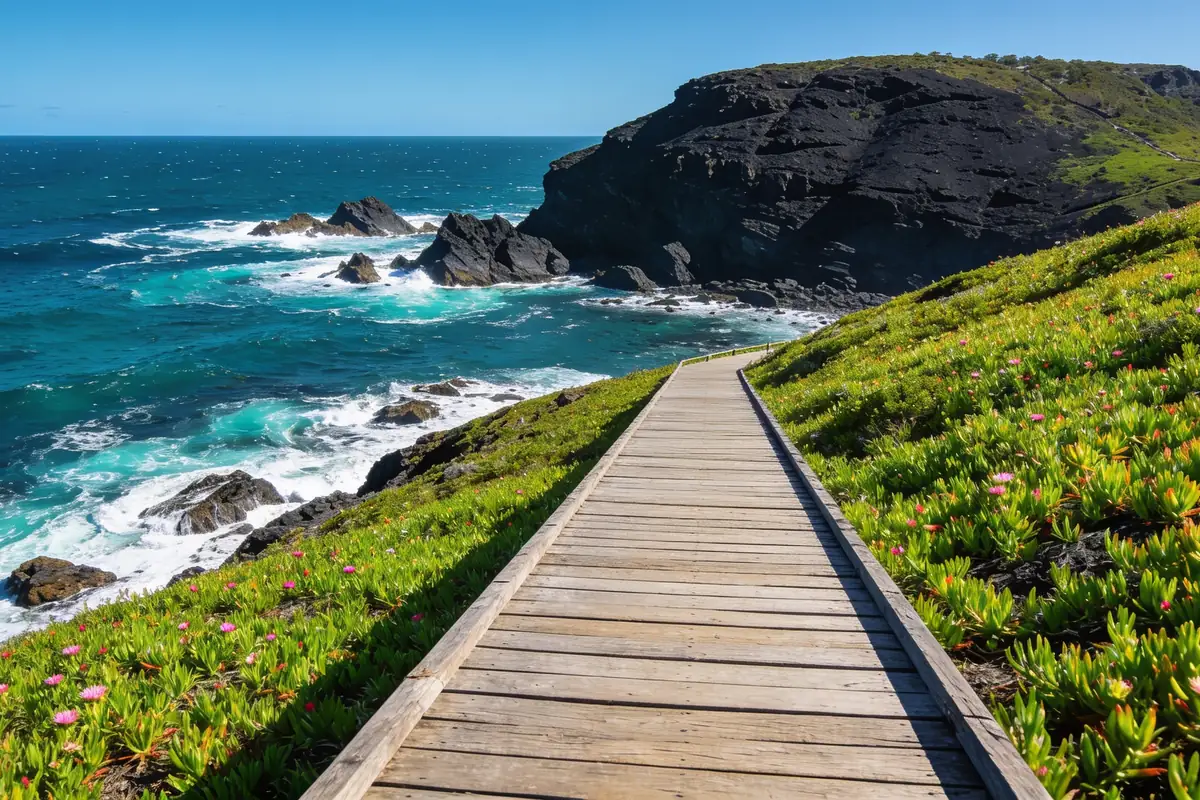
As at 13 January 2026, the Nobbies boardwalks and car park are open, but the Nobbies Centre, its cafe and its toilets are closed. A visitor planning to eat or use facilities there should plan around that, and a stop in Cowes beforehand makes it easy. The walk itself needs no building. The cliff, the rock and the water are the attraction.
A third stop is optional, and it is a matter of ticket choice. The Nature Parks sell a 3 Parks Pass that covers the Penguin Parade, the Koala Conservation Reserve and Churchill Island Heritage Farm. It suits a visitor with a long day and a taste for all three. No price is printed here, because prices belong on the Nature Parks’ own pages and can change. A visitor with less time can skip the pass, take the Penguin Parade ticket alone and add one stop.
None of these needs to be a rush. The aim is for the afternoon to end with the car parked, a jacket on and some time in hand.
What the beach asks of a visitor
The beach asks for very little, and most of it is clothing. The Nature Parks describe the parade as an all-weather event and advise warm clothes and a raincoat if rain is forecast. Some past visitors suggest a jacket even in summer, and the FAQs point the same way: the parade is at sunset and outside. A rug for the seats is also handy, which is the Nature Parks’ own tip.
The visitor centre opens from 12pm daily, with a cafe, a shop and toilets. That gives anyone who arrives early somewhere to wait out the last hour before the walk to the grandstand.
Then comes the camera rule. The Nature Parks ask that cameras, camcorders and camera phones not be used after sunset. The Nature Parks give the reason in their FAQs: penguins have sensitive eyes, and a bright, sudden flash or an unusual light can frighten or disorientate a penguin. The rule is for the animals coming ashore, and it applies to camera phones as much as to cameras. The visitors who follow it get the beach as it is, in the dark, with nothing to hold up.
Access is straightforward. The paths are wide, the boardwalks have ramp access and there are wheelchair viewing areas.
None of this makes the parade a wild beach. It is an organised attraction, with grandstands, a visitor centre and a booking system, and some visitors call it a production. That is a fair reading. Those who want a quieter evening can choose a weeknight outside the school holidays, or a winter visit, because the parade runs every night of the year. Others say it is worth the effort as long as the ticket is booked ahead.
Getting there without a car
Then there is the practical question: can the day be done without a car? Partly. V/Line runs a bus to Cowes from Southern Cross, but it does not go to the Penguin Parade, and there are no return buses after it. The Nature Parks’ FAQs say public transport does not operate between the parks. The bus gets a visitor to the town. It does not get them to the beach, or home from it after dark.
Advice from past visitors online points to a car or a coach tour, and the Nature Parks’ FAQs say the same: without your own transport, they recommend a coach tour. Coach tours exist for visitors without a car, and no operator is named here, because the right one depends on where the visitor starts and which ticket they want. The point is to settle it before the day, since the last bus is the one thing that cannot be improvised after dark.
Back Over the Bridge in the Dark
The grandstand empties slowly, in a tide of folded rugs and low voices. The boardwalk leads back through the tussock to the car park, where engines start one by one and headlights swing across the dunes. Nobody is in a hurry, and nobody quite wants to leave.
The Nature Parks give one last piece of advice, and it matters most on the way out. Take care on island roads at dawn, dusk and night, when wildlife is active. After the parade that means slowing down on the dark road to the bridge and watching the verges.
Some visitors turn the evening into an overnight. A place to stay overnight is the slower option, with no bridge and no night drive waiting at the end of the evening, and a morning on the island with nowhere to be. Anyone who wants a beach with nobody on it will find one a long way north, on a much quieter coast in the Top End, though that is a different trip.
The headlights reach the bridge. Behind them, the beach is empty again, and the tide has the sand to itself.
Sources: Phillip Island Nature Parks, Penguin Parade (https://www.penguins.org.au/attractions/penguin-parade/); Phillip Island Nature Parks, Frequently Asked Questions (https://www.penguins.org.au/faqs/)