
Ride Puffing Billy in the Morning and Keep the Afternoon for the Dandenong Ranges
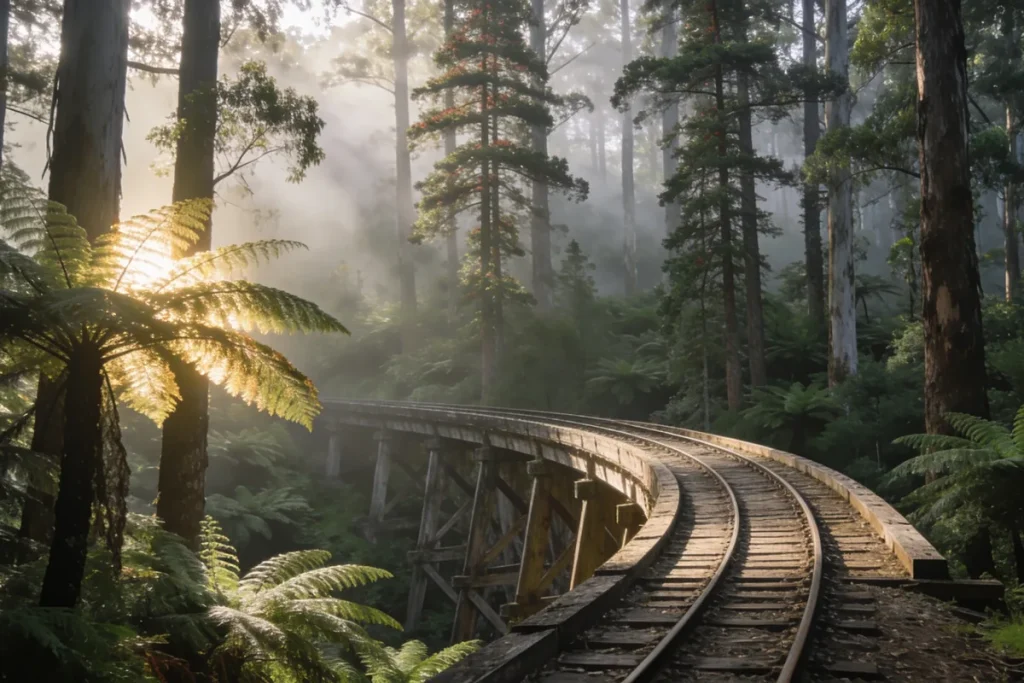
Steam is already drifting across the platform at Belgrave when the first train of the morning gets ready to leave. It rolls low along the rails and thins out before it reaches the end of the station, and in spring the air behind it is cool enough to carry the smell of coal smoke and wet bark a long way. A bell sounds. A conductor walks the length of the carriages, helping passengers up into the open-sided seats, checking latches, nodding at the children who have claimed the end with the best view.
Then Puffing Billy pulls out with a long, slow breath, and the town drops away behind it. The first curve takes the line into a fern gully. Tree ferns lean over the track, and behind them stands mountain ash, pale and straight and so tall that the canopy seems to belong to a different sky. For a few minutes nobody in the carriage says much. They simply look.
That is the morning, and it is a good one. It is also easy to let it swallow the whole day. The Dandenong Ranges hold a great deal more than a railway, and the ride works best as the first half of a plan rather than all of it. The train takes the morning. The forest, a short drive from Belgrave, takes the afternoon. The halves fit together with a little booking ahead, and a spring visitor should look at the fire danger rating before anything else.
The Puffing Billy line out of Belgrave
The line was built in 1900 to serve the hill communities, and the goods it carried in those early years say a good deal about the country it crosses: passengers, timber, livestock, potatoes and plants. It is now run with the help of more than 300 volunteers, and it operates every day of the year except Christmas Day. The railway puts the full line at 24 kilometres, from Belgrave to Gembrook, over the timber trestle bridge, crossed within minutes of leaving Belgrave, that gives the ride its look in photographs.
Belgrave itself is about 40 kilometres and an hour east of Melbourne, by the railway’s own description. The rest of a day here leans on local businesses in Victoria, a café at one end and perhaps a bed at the other, and both come up below.
The railway offers four journeys. The figures here are its own, given as it gives them, each with a longer “allow” time to plan around.
- Belgrave to Menzies Creek: 25 minutes each way, and the railway says to allow two hours. There is a museum at the stop.
- Belgrave to Lakeside: one hour each way, allow four hours. Lakeside has a visitor centre, a café and Emerald Lake Park.
- Lakeside to Gembrook: 45 minutes each way, allow three hours.
- Belgrave to Gembrook: one hour 50 each way, allow six hours.
Six hours is a long day on a train with open sides, and it leaves no room for anything else. Most of what follows assumes the second option on the list, which is the one the railway’s own figures make easiest to build a day around.
Booking ahead, and the carriage sills
The railway is plain about booking. Its visit page says bookings are essential, and that all visitors are required to book tickets online. There is no turning up at the platform on the day and hoping for a seat, which is worth knowing before a spring Saturday is pencilled in. This post prints no fares, departure times or ticket types, because those sit on the railway’s own booking pages, and that is the place to read them.
The open sides are the point of the ride, and they come with rules that a family needs before booking rather than on the platform. Legs over the side is the part people remember. The railway’s journey guide adds the rules.
- Children under 4 are not permitted to sit on the sill.
- Children aged 4 to 13 need adult supervision, with a maximum of two children per adult, and each within arm’s reach.
- Everyone stays seated. No standing and no climbing.
- Sitting on the sill is not allowed after sunset, or during school excursions.
The sunset rule is worth remembering in the shorter days of the year. The rules also change who the day suits. A family with a child under 4 should know that the child does not sit on the sill at all, and plan the ride with that in mind. Nobody has to be disappointed by it. They only have to know it before the booking is made.
Why the morning train suits the day
Here is the planning method, offered as exactly that and not as a timetable. It rests on one figure: the railway’s own allowance of four hours for a Belgrave to Lakeside return. Start that journey on a morning train and the day arrives back at Belgrave in time for a late lunch, with the afternoon still open and the ranges a short drive away. Nothing in it depends on a particular departure time, which this post does not give.
Lunch can be eaten at either end. Lakeside Visitor Centre has free entry and both indoor and outdoor dining, so a meal there is one option. The other is to ride back, walk out of the station and find a café for lunch in Belgrave before driving up into the hills. Both work. The second has the advantage of putting the whole railway behind you before the forest begins.
For a family with small children, the Menzies Creek return is the gentler version. The railway says to allow two hours, which leaves most of the day untouched, and a child who has had a morning of steam and a stretch of fern gully may be happy to spend the afternoon on a flat picnic ground. A shorter ride is a sound choice and not a lesser one.
Anyone turning the trip into an overnight visit can look for somewhere to stay in the hills. The plan then stretches over two days, with the forest on one and the train on the other, and neither has to be squeezed.
Spring brings fire danger days
Spring in the hills is lovely, and it is also the season in which a plan can fall over. Both halves of this one depend on the forecast in ways that are easy to miss.
The railway’s fire strategy page is direct. On days of Total Fire Ban, or extreme weather events in the Central Zone or the whole state of Victoria, no trains will operate. Services can be cancelled at short notice, and the railway says it tries to contact ticketholders when that happens. On Catastrophic days it is closed outright, with no staff or volunteers on the premises.
The forest has its own rule. Parks Victoria says the entire Dandenong Ranges National Park, including the 1000 Steps at Ferntree Gully, closes on days when the Fire Danger Rating is Extreme or above. A single forecast can therefore take out the morning and the afternoon together.
One conflict deserves a ruling. Some older pages say a diesel locomotive stands in for steam on Total Fire Ban days, so the trip goes ahead behind a different engine. The railway’s current fire page, last modified on 11 February 2026, says no trains operate. The current page governs, and nobody should plan around a diesel stand-in.
The habit that covers all of this is a check the evening before. Read the Country Fire Authority’s fire danger rating for the district, then the railway’s own site, then Parks Victoria’s. If the rating is high, the plan changes, and the railway’s page is the one to read for what that does to a booking.
The afternoon under the mountain ash
The forest does not need a plan the way the railway does. It needs walking shoes and a clear forecast.
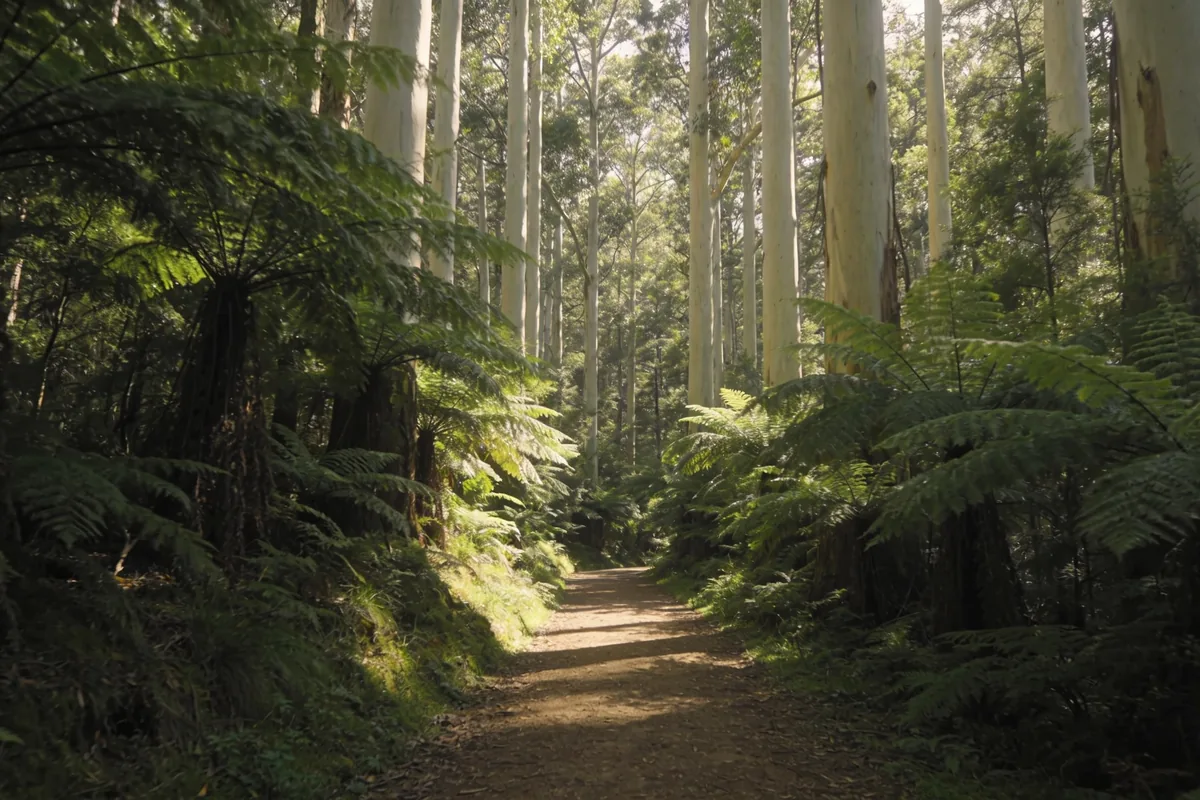
Parks Victoria describes the Dandenong Ranges National Park as steep volcanic hills covered in mountain ash, which it calls the world’s tallest flowering tree. Lyrebirds, wallabies, wombats and the powerful owl all live among them. Parks Victoria describes the park as part of an Aboriginal cultural landscape in the traditional Country of the Wurundjeri People. Dogs are not allowed anywhere in the national park, Sherbrooke Forest included.
Sherbrooke Picnic Ground sits at the edge of that forest, which Parks Victoria calls a magnificent and endangered cool temperate rainforest. From the picnic ground a walk leads out to Sherbrooke Falls. The ground rules are short and worth reading properly: no dogs, no bicycles, no fires, and a plain warning that limbs may fall. Under trees this tall, that is not a line to skim.
The light does something particular here in the afternoon. It comes down through the canopy in pieces, lands on a patch of fern, moves on. The track runs cool and green, and the smell is of damp leaf litter and eucalyptus. A visitor who has spent the morning in a carriage, watching the bush from the side, now walks inside it.
For a harder afternoon there is the 1000 Steps, which starts from the Ferntree Gully Picnic Area. Parks Victoria calls it an energetic walk. It also carries a quieter meaning, through its association with the Kokoda Track campaign and with Australia’s Second World War veterans. It is not a stroll, and it suits a day when legs are in good shape.
Parks Victoria says Olinda Falls and Sherbrooke Falls are at their best after rain, so a recent wet spell lifts the afternoon, and walking shoes are the sensible footwear for all of it. A dry spell leaves the falls thinner, but the trees do not change. All the afternoon asks for is the drive, a pair of shoes and a forecast that has not closed the park.
Is it worth the money?
Among people who post about it online, the view is warmer than the price might suggest: parents of small children and grandparents alike describe it fondly, and the scenery is often called lovely. Locals are harder to please on cost. A common view among them is that the railway is pricey and has to be booked weeks ahead, and that school holidays book out.
That is a fair point, and this post does not argue with it. The railway is not cheap, and a family with a tight budget or a small child is entitled to wonder whether the longest ride earns its money. A shorter journey suits both. Some parents of toddlers online say as much: keep it to Belgrave to Lakeside or less.
The honest answer is that a shorter return still gives the sill, the steam and the trestle bridge. The Menzies Creek return, which the railway says to allow two hours for, offers the heart of the experience at a fraction of the time, and it leaves the rest of the day for a forest that asks for nothing but the drive. Whether the full ride is worth the money is a judgement for each household. Whether the morning train is worth taking is easier to answer, and the answer is yes, if it has been booked ahead and the forecast is kind.
Back at Belgrave
The whistle sounds once more as the train eases back into Belgrave, and the platform fills with people stepping down into the cool air, a little windblown, smelling faintly of smoke. Lunch comes next. Then the road up into the ranges.
By the afternoon the track under the mountain ash is dim and green, and somewhere ahead is the sound of water. The day goes in two halves, and the second one is quiet.
Sources: Puffing Billy Railway, Guide to your journey (https://puffingbillyrailway.org.au/journey/); Puffing Billy Railway, Total Fire Ban days and fire strategy (https://puffingbillyrailway.org.au/about/environment/fire-strategy/); Puffing Billy Railway, About Puffing Billy (https://puffingbillyrailway.org.au/about/); Puffing Billy Railway, Visit us (https://puffingbillyrailway.org.au/visit-us/); Parks Victoria, Dandenong Ranges National Park (https://www.parks.vic.gov.au/places-to-see/parks/dandenong-ranges-national-park); Parks Victoria, Sherbrooke Picnic Ground (https://www.parks.vic.gov.au/places-to-see/sites/sherbrooke-picnic-ground)